The Payday Loan Debt Trap: How a $500 Loan Becomes $3,000
It starts with a $500 emergency: a car repair, a utility bill, a gap between paychecks. The payday lender hands over the cash in minutes, and the price looks small: a $75 fee, due in two weeks. Then payday arrives, and after rent and groceries there is not $575 left to hand back. The lender offers an easy fix: pay the $75 fee, roll the loan over, and try again in two weeks. That one decision is the doorway to the debt trap, and it is why a $500 loan can cost $3,000 before it is finally gone.
Key Takeaways
- A typical payday loan charges $15 in fees for every $100 borrowed, which works out to about 391 percent APR on a two-week loan.
- About 80 percent of payday loans are rolled over or reborrowed within two weeks, according to the Consumer Financial Protection Bureau.
- Rolling over a $500 loan just a few times can add more in fees than the original amount borrowed, with the principal untouched.
- The median payday borrower is in debt for 199 days of the year, and roughly half of all payday loan sequences run ten or more loans in a row.
- The trap is structural: lump-sum repayment, no affordability check, direct access to your bank account, and fees that reset with every rollover.
How a Payday Loan Actually Works
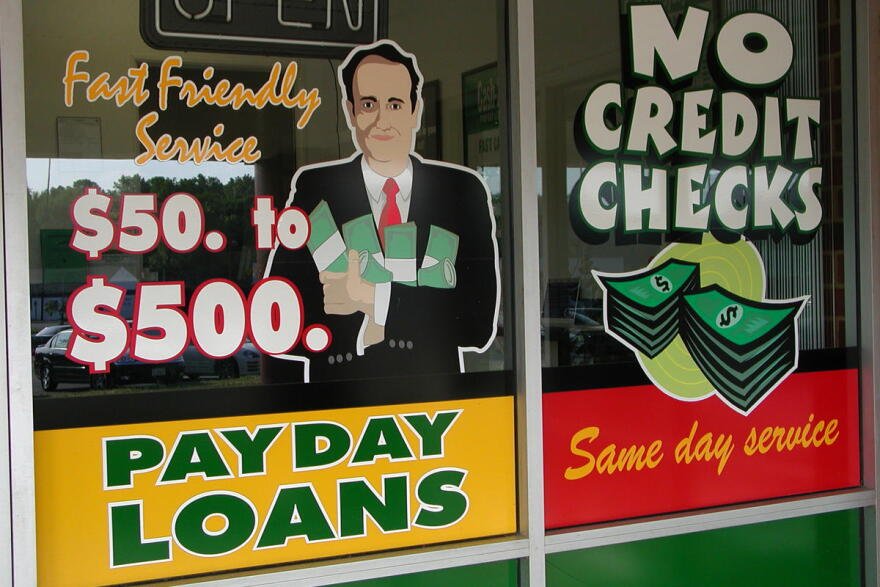
A payday loan is a small, short-term loan, usually $100 to $500, meant to be repaid in full on your next payday, typically within two to four weeks. You do not pay interest in the traditional sense. Instead, you pay a flat fee: most commonly $15 for every $100 borrowed, though fees range from $10 to $20 per $100 depending on the state and lender. To secure the loan, you give the lender a postdated check or authorize an automatic debit from your checking account.
The fee framing is deliberate. Fifteen dollars per hundred sounds like the price of convenience, not like a loan at all. But annualized, that fee is staggering. A $15 fee on a $100 two-week loan is equivalent to 391 percent APR, roughly twenty times the rate of a typical credit card. Borrow $500 at the same rate and you owe $575 in fourteen days: $500 of principal plus a $75 fee. That math is the entire business model, and it is perfectly legal in most states.
The Rollover: Where the Trap Springs
The trap is not the first loan. It is what happens on payday. The CFPB found that most borrowers cannot afford to repay the full amount and still cover basic expenses, so about 80 percent of payday loans are rolled over or reborrowed within two weeks of the previous loan. A rollover works like this: you pay the fee again, the due date moves out another two weeks, and the principal stays exactly where it was.
Think about what that means in dollars. Each rollover on a $500 loan costs another $75, and none of it reduces what you owe. Two rollovers add $150 in fees. Six add $450. At that point you have paid nearly as much in fees as you borrowed, and you still owe the original $500. Lenders have every incentive to offer this option, because fees are revenue and a borrower who pays in full is a customer who leaves.
The Worked Example: How $500 Becomes $3,000
Here is the month-by-month reality of rolling over a $500 payday loan at $75 per two-week period, the exact fee structure the FTC uses in its consumer education example:
| After | Fees paid so far | Total cost including principal |
|---|---|---|
| Initial loan | $75 | $575 |
| 2 rollovers (6 weeks) | $225 | $725 |
| 6 rollovers (14 weeks) | $525 | $1,025 |
| 13 rollovers (6 months) | $1,050 | $1,550 |
| 20 rollovers (9 months) | $1,575 | $2,075 |
| 33 rollovers (15 months) | $2,550 | $3,050 |
The pattern is relentless and linear: every two weeks adds $75, and the principal never shrinks. Pew Charitable Trusts found that the average payday borrower pays about $520 in fees over a year just to keep repeatedly borrowing the same $375. The CFPB’s data is even grimmer for heavy users: nearly half of borrowers have more than ten transactions a year, 14 percent have twenty or more, and the median borrower is indebted 199 days out of the year. A borrower who rolls a $500 loan for fifteen months has paid $3,050 for $500 of borrowed money, more than six times the original loan, and this is not a hypothetical. It is what the rollover statistics describe.
The APR Reality Check
Translating the fee into an annual percentage rate makes the trap visible at a glance:
| Borrowing option | Cost of $500 for two weeks | Approximate APR |
|---|---|---|
| Payday loan ($15 per $100) | $75 | 391% |
| Credit card cash advance | About $10 to $15 plus a fee | 25% to 30% |
| Credit union PAL | About $5 to $11 | 28% max |
| Standard personal loan | About $3 to $8 | 10% to 20% |
The APR comparison also reveals why payday lending concentrates in the gaps other lenders leave. People who cannot access a credit card or a personal loan have few alternatives, and the lender’s price reflects that lack of competition. The problem is not that borrowers are careless. It is that the product is engineered around a repayment structure most borrowers cannot meet.
Why the Structure Traps Borrowers: Five Design Features
First, lump-sum repayment. Unlike an installment loan, the entire balance comes due at once, out of a single paycheck that was already too small. That design all but guarantees a large share of borrowers cannot pay in full.
Second, no affordability check. For years, payday lenders were not required to verify that a borrower could repay the loan and still meet basic living expenses. The loan is underwritten on the borrower’s next paycheck existing, not on the borrower being able to part with it.
Third, direct access to the bank account. The postdated check or ACH authorization puts the lender first in line on payday, ahead of rent, utilities, and groceries. When the debit clears, the shortfall it creates becomes the reason for the next loan.
Fourth, the fee resets with every rollover. Each renewal is priced as if it were a new loan, so fees compound in effect even though the principal never grows. Online borrowers face an added sting: the CFPB found that half of online payday borrowers rack up an average of $185 in bank penalties from repeated debit attempts.
Fifth, the cycle is self-reinforcing. CFPB research shows that for the majority of borrowers, a new loan is taken out the same day the previous one is closed, or shortly after. Within a month, almost 70 percent of borrowers have taken out a second loan, and one in five new borrowers ends up taking ten or more in a row. Each loan feels like a fresh start. It is the same debt wearing a new date.
FAQ
Is it true that most payday borrowers cannot afford the loan?
Yes. The CFPB’s research found that most consumers who take out payday loans cannot afford to repay the full amount owed by their next paycheck, which is why rollover and reborrowing rates are so high. The lump-sum structure, not borrower behavior, is the primary driver of the cycle.
Can a payday lender really charge 400 percent interest?
In most states, yes. Payday lending is regulated state by state, and the typical fee of $10 to $20 per $100 borrowed translates to APRs of roughly 300 to 600 percent on a two-week loan. Some states cap fees or ban payday lending outright, which is why costs vary so much by location. See our state-by-state guide for where you live.
What happens if I just stop paying a payday loan?
The lender will attempt to debit your account, which can trigger overdraft fees, and will eventually send the debt to collections, which can damage your credit. Simply ignoring it is not a strategy. A better move is to request an extended payment plan, which freezes fees and splits the balance into installments, or to work with a nonprofit credit counselor.
Are payday loans worse than credit card debt?
On cost, yes, by a wide margin. A credit card at 25 percent APR costs a fraction of a payday loan at 391 percent, even though both can trap borrowers who only make minimum payments. Read about the minimum payment trap to see how slow repayment multiplies costs on cards too, just on a longer timeline.
What should I do instead of taking a payday loan?
Ask the biller for a payment plan, look into a credit union Payday Alternative Loan (capped at 28 percent APR), or contact a nonprofit credit counseling agency for free guidance. If you are already juggling several debts, our guide to options for $20,000 in debt walks through prioritizing and consolidating them.
The Bottom Line
The payday loan debt trap is not an accident and not a character flaw. It is the predictable result of a product that charges $15 per $100, demands it all back in two weeks, and profits most when the borrower cannot pay. The numbers tell the story plainly: 80 percent of loans are rolled over or reborrowed, the median borrower is indebted more than half the year, and a $500 loan rolled over long enough costs $3,000. Understanding the mechanics is the first step, because once you see the trap, you can use the exits that exist: the extended payment plan, the credit union PAL, and the counselor who has seen this cycle a thousand times.
Sources
- Consumer Financial Protection Bureau, “The CFPB Finds Payday and Deposit Advance Loans Can Trap Consumers in Debt,” 2014. consumerfinance.gov.
- Consumer Financial Protection Bureau, “We’ve proposed a rule to protect consumers from payday debt traps.” consumerfinance.gov.